MoStart 2026: IT Day Focused on Artificial Intelligence, Startups, and the Digital Economy
MoStart 2026: IT Day Focused on Artificial Intelligence, Startups, and the Digital Economy
23.04.2026 16:27:17
543
543
23.04.2026 16:27:17
A strong focus on artificial intelligence, the development of global technology products, and changes in the labor market marked the second day of the MoStart conference, an event organized by the University of Mostar and the Information Technologies Center SUMIT. Through a series of lectures and panel discussions, the conference offered concrete insights into the direction of the modern IT industry.
In this context, Damir Sabol, Director of Software Engineering at Google and founder of the Photomath app, spoke about the development of the application—from an idea born out of a common homework problem to a global product used by millions. “I started with the idea that this project would solve a problem for many people, especially parents, and I was quite confident in that. I didn’t expect the product to become so big—I knew it would be interesting, but not that nearly everyone would need it. Only after we launched it on the market did it become clear that it was something significant and worth investing much more time and attention into,” Sabol said, adding that success is the result of combining advanced technology with a simple user experience.
Transformation of Modern Society
The central part of the program was marked by the panel “Civilization 2.0 – AI as the Tailor of a New Era of Humanity,” which featured leading figures from the regional tech scene—Dženan Lojo (TIS Group), Matija Matijevac (Maidea), Marko Laco (Ito), and Senad Šantić (ZenDev), moderated by Petar Štefanić. The discussion addressed profound changes that artificial intelligence is bringing to the labor market and society as a whole, emphasizing that technology is no longer just a tool, but a key factor redefining business models, work organization, and everyday life.
Particular interest was also generated by a discussion on the future of financial technologies, in which Hrvoje Ćosić, CEO of Aircash, spoke about the transformation of digital money and changes in user habits. “Digital finance is changing the world—from how we develop products to how users pay and shop. The habits of younger generations are especially important, as we enable simpler and faster payments, online shopping, and overall easier money management,” Ćosić stated, also emphasizing the importance of security mechanisms in the digital environment.
An inspirational dimension was added to the program through a conversation with Karlo Vrančić, a student at Harvard and MIT, who shared his personal experience of combining sports, science, and entrepreneurship, demonstrating how ambition and interdisciplinarity open doors to global success.
Innovation, Startups, and Digital Literacy
The startup perspective was presented by Matija Matijevac in a lecture on missed opportunities and the psychology of innovation, highlighting that the difference between failure and global success often lies in persistence and timely recognition of an idea’s value. Through concrete examples, participants gained insight into the dynamics of developing technological products and the challenges faced by entrepreneurs. Practical insights into the startup ecosystem were further provided by Dragan Petric through an overview of the best and worst practices of successful and unsuccessful startup projects.
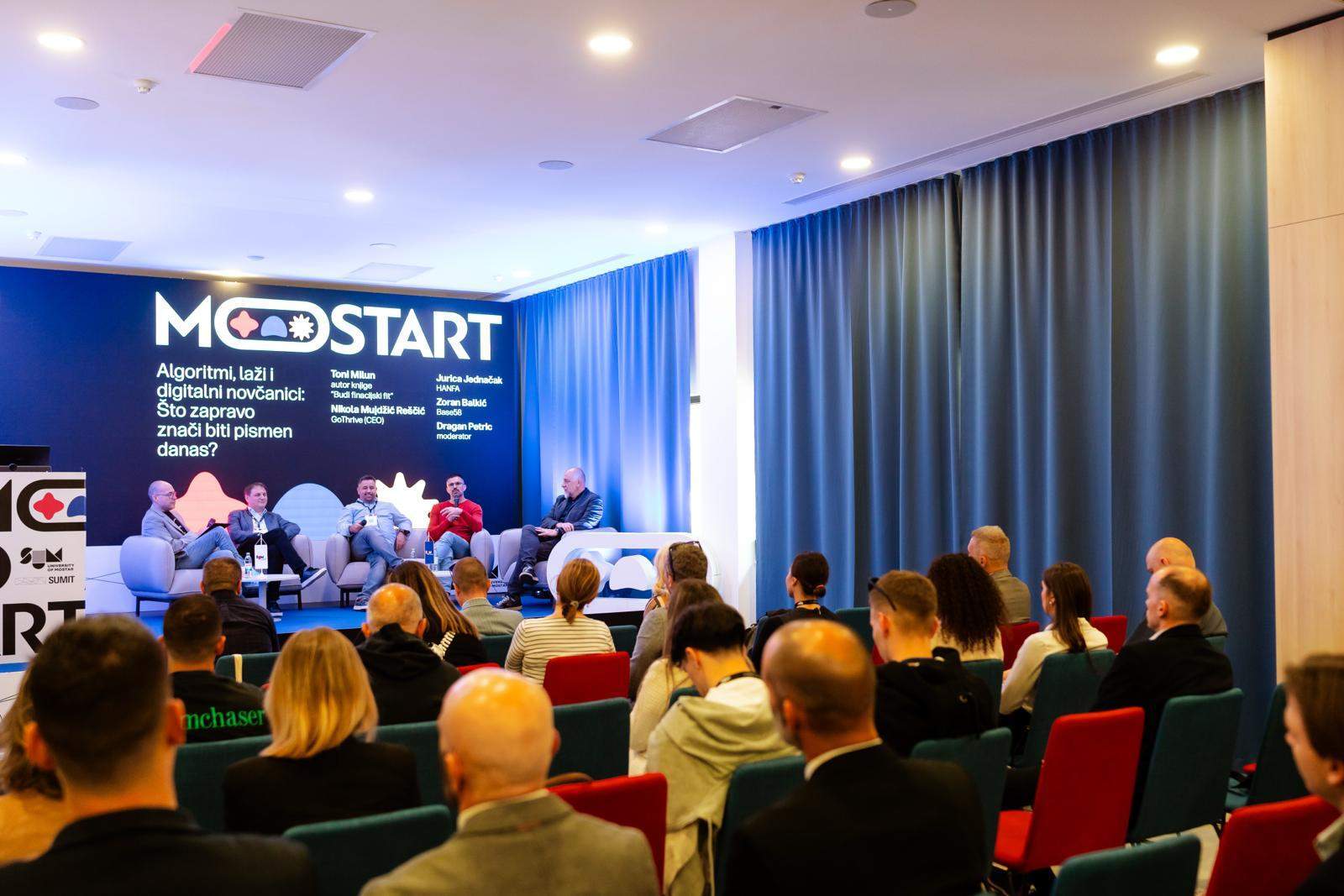
The final panel, “Algorithms, Lies, and Digital Wallets: What Does It Really Mean to Be Literate Today?” addressed one of the key questions of modern society—how to navigate a world in which technology increasingly mediates our relationship with information, money, and everyday decisions. Participants included Toni Milun (author of “Be Financially Fit”), Nikola Mujdžić Reščić (GoThrive), Jurica Jednačak (HANFA), and Zoran Balkić (Base58), moderated by Dragan Petric. The focus was on the challenges of digital literacy in a time of rapid development of artificial intelligence and digital finance, emphasizing that the ability to recognize credible information is becoming just as important as understanding the technologies shaping modern society.
In this context, Toni Milun highlighted the high quality of the conference and the many useful and practical insights, especially for young people. He emphasized that the key message for youth should focus on developing financial habits early—starting from the first income, thinking about investing, and entering the workforce as early as possible to build long-term work and development habits.
He also warned about the increasing prevalence of online scams, noting that he himself discovered a fake video of him circulating online, created last year. Although it can be recognized as not authentic, he pointed out that today’s AI tools enable the creation of highly convincing fake videos, making it increasingly difficult to distinguish truth from manipulation. This further highlights the importance of digital caution and critical thinking.
A Conference That Connects People and Ideas
The significance of the conference was also highlighted by Prof. Dr. Tomislav Volarić, Vice-Rector for Digitalization and Technology Transfer at the University of Mostar, who emphasized that MoStart is the result of continuous work and the joint efforts of many people.
“MoStart is not built overnight—behind such a conference stands a large number of people, from the organizing team to volunteers. We are especially pleased that speakers are happy to return, which confirms the quality of the content, as well as the value of networking and knowledge exchange that the conference provides,” Volarić said.
The second day of the conference once again confirmed that MoStart is an important platform for connecting industry, the academic community, and young talent, as well as a space for addressing key questions about the future of technology and society as a whole. The final day of the conference is dedicated to science.