No Application Without Science: MoStart 2026 Demonstrates How Science Builds the Digital Future
No Application Without Science: MoStart 2026 Demonstrates How Science Builds the Digital Future
The Scientific Day, the third thematic day of the fourth edition of the international MoStart conference, once again confirmed MoStart’s status as a relevant platform that connects scientists, the academic community, and industry with the aim of developing sustainable solutions to the challenges of the digital age. This year’s edition further emphasized its scientific significance, with more than 230 authors submitting scientific papers, some of which will be published in cooperation with the publisher Springer, thereby confirming the conference’s international visibility and academic relevance.
The Scientific Day program was opened with keynote addresses by representatives of the University of Mostar: Prof. Dr. Sanja Bijakšić, Vice-Rector for International Cooperation, and Prof. Dr. Daniel Vasić, President of the MoStart 2026 conference. Prof. Bijakšić highlighted that the Scientific Day is dedicated to the future of the European research and innovation area. “The exchange of ideas, sharing of knowledge, and striving for progress are the foundations of the development of the European space,” she stated, emphasizing that conferences like MoStart create opportunities for connecting the academic community, researchers, and experts, while opening discussions on key issues of digital transformation, science, and innovation.
Prof. Vasić stated that this year’s MoStart reaffirms its role as a relevant platform for collaboration and knowledge exchange in the field of technologies shaping the future. He emphasized that the Scientific Day program includes presentations of scientific papers, thematic sessions, and keynote lectures by distinguished experts, providing participants with a comprehensive insight into contemporary research trends and challenges.
“Technology is already changing the way we learn, teach, and work, and gatherings like this enable the exchange of knowledge and experiences necessary to understand these changes,” Vasić said, stressing the importance of participation by students and doctoral candidates as key drivers of future innovation. He also added that artificial intelligence should be viewed as a tool in service of humanity, requiring responsible guidance and application.
Science in the Service of Contemporary Challenges
A lecture titled “Mental Health, Stress Resilience, and Artificial Intelligence” was delivered by Prof. Dr. Krešimir Ćosić from the University of Zagreb. In his presentation, mental health was viewed not only from a clinical perspective, but also as a set of cognitive and emotional abilities that enable effective functioning in demanding and unpredictable environments.
The program continued with the lecture “Artificial Intelligence in Computer Vision Applications: How to Collect Images for Training”, delivered by Prof. Dr. Rainer Herpers from the Bonn-Rhein-Sieg University of Applied Sciences (Germany) and the University of New Brunswick (Canada). In his presentation, Herpers demonstrated advances in AI-based object detection and classification, emphasizing that recent years have brought significant improvements in computer vision performance. He also noted that while AI systems are increasingly successful in interpreting visual information, they still depend on a crucial factor—high-quality training data.
Interdisciplinary Research and Applications of Artificial Intelligence
Within the thematic sessions, numerous studies were presented from the fields of medicine, climate science, agriculture, and data analysis. Applications of artificial intelligence covered a wide range—from health risk assessment and time-series analysis to the development of intelligent systems for recognizing and interpreting complex data.
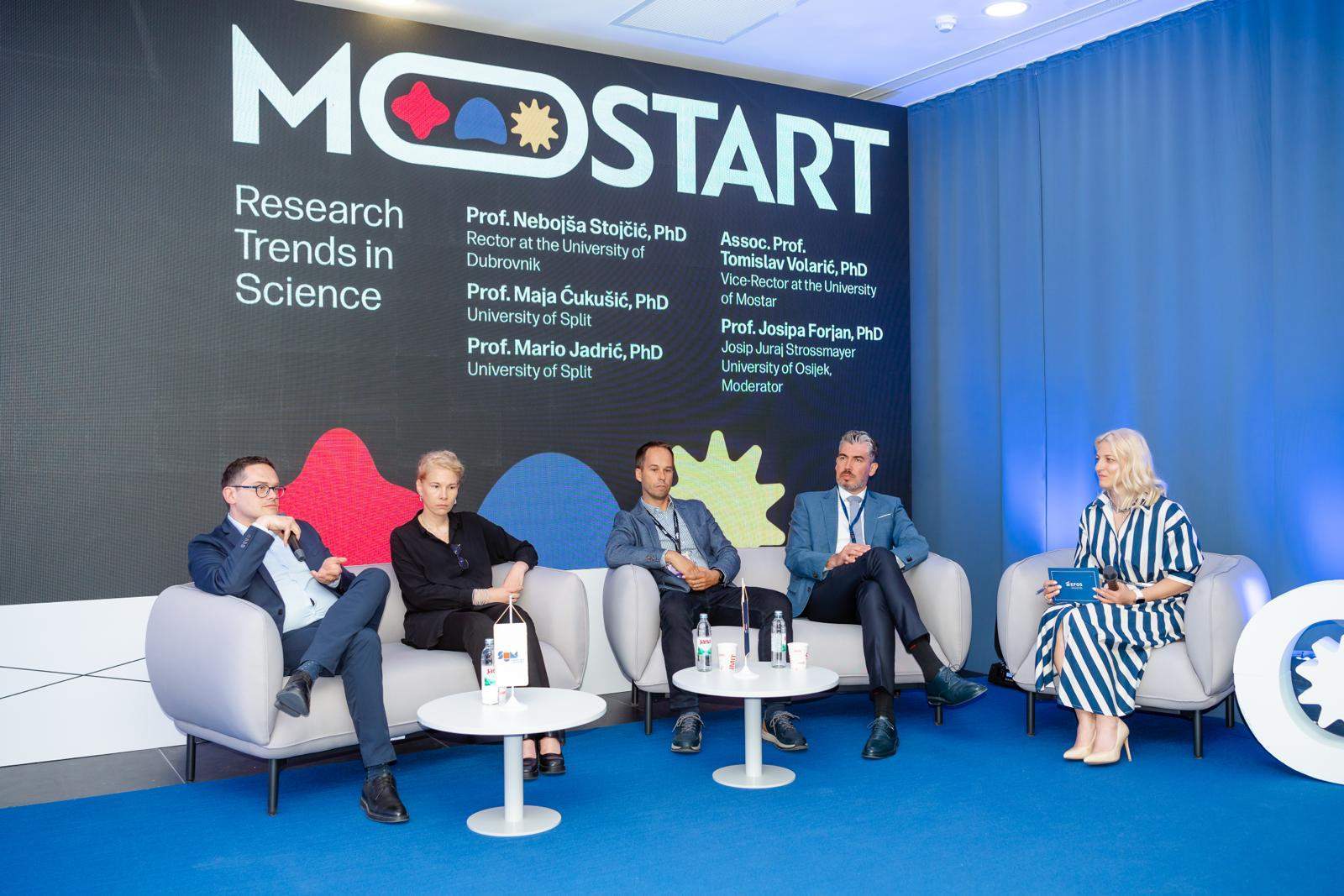
The changing face of modern science was highlighted in the panel session “Research Trends in Science,” which brought together prominent academic experts from the region as part of MoStart 2026. Through the exchange of experiences and insights, participants opened a discussion on the directions of contemporary research, as well as the challenges and opportunities of a dynamic academic environment.
Participants included Prof. Dr. Nebojša Stojčić, Rector of the University of Dubrovnik; Prof. Dr. Maja Ćukušić and Prof. Dr. Mario Jadrić from the University of Split; and Prof. Dr. Tomislav Volarić from the University of Mostar, with moderation by Prof. Dr. Josipa Forjan from Josip Juraj Strossmayer University of Osijek. The discussion addressed the direction of contemporary research and the selection of relevant topics, with Stojčić emphasizing that themes related to key global transformations—such as green and digital transitions—are of particular importance today. “It is important to deeply engage with the literature, understand what has already been researched, where the gaps are, and where you can contribute,” he noted, adding that feasibility must also be taken into account.
Poster Session as a Space for Interdisciplinary Exchange
The poster session of MoStart 2026 represented a dynamic and interactive part of the program, showcasing current scientific work in progress, with a focus on artificial intelligence, computer vision, and digital transformation.
The presented works covered a wide range of topics—from biomedical data analysis and the identification of phenotypes of autonomic fatigue using unsupervised AI methods, to autonomous drone landing using computer vision and simulation frameworks based on AprilTag and ROS 2–PX4 systems, as well as generating vector graphics from textual descriptions using multi-agent AI systems.
The poster session thus served as a meeting point for different disciplines and ideas, where direct interaction between authors and participants enabled the exchange of experiences, testing of concepts, and the opening of new opportunities for collaboration.
The Scientific Day of MoStart 2026 once again confirmed the importance of linking theoretical knowledge with practical solutions, supported by a strong interdisciplinary approach and the inclusion of researchers of all generations in shaping future scientific and technological trends.