Second Day of the SuProM Workshop: Practical Skills and Strategic Management of EU Projects
Second Day of the SuProM Workshop: Practical Skills and Strategic Management of EU Projects
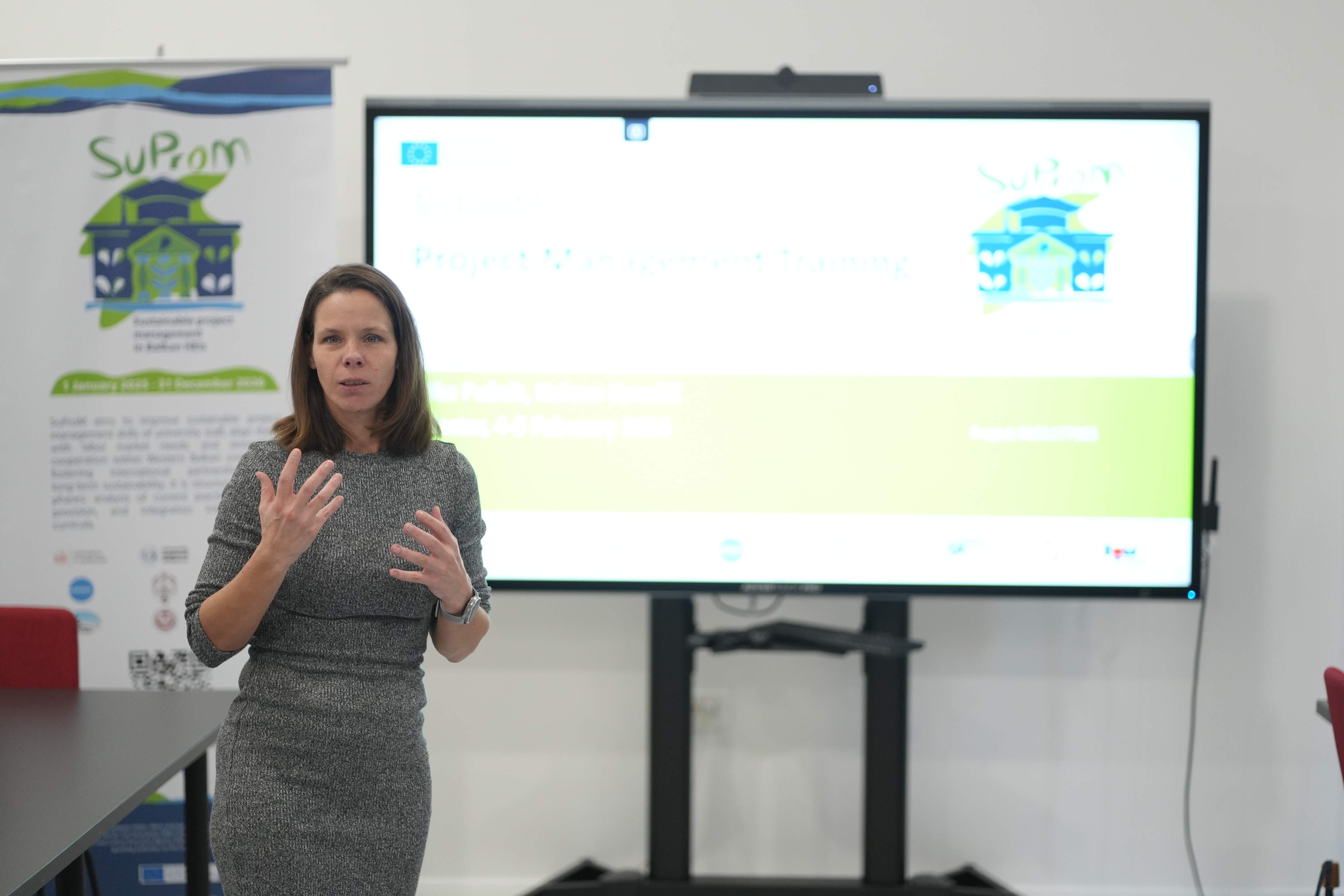
The second day of the SuProM workshop at the University of Mostar was dedicated to thematic workshops conducted by the University of Ljubljana, the project’s lead coordinator. The sessions allowed participants to further deepen their practical knowledge and skills necessary for the successful preparation, implementation, and long-term sustainability of EU projects, with a particular focus on project roles, processes, and the application of tools within EU initiatives.
“Projects are dynamic systems that require collaboration between academic, administrative, and financial staff. Transparency, shared responsibility, and compliance with EU regulations, such as the Erasmus+ programme and EACEA guidelines, are crucial for smooth and effective implementation,” the workshop leaders emphasised. The workshops particularly highlighted the main stages of project design and management, explaining how objectives, work packages, deliverables, and resources are connected into a coherent and feasible project plan. “We also covered the distribution of roles, process orientation, and compliance with EU requirements, particularly in administrative and financial management,” they added.
Strategic Significance and Long-term Impact of the SuProM Workshop
Expert insights further highlighted the strategic importance of the project and its impact on higher education. Prof. Dr. Elvis Ahmetović, Head of the SuProM project at the University of Tuzla, stressed the importance of a professional and strategic approach to project management.
“The SuProM project represents a significant initiative that promotes more efficient and sustainable project management at higher education institutions across the Western Balkans,” he stated.
Prof. Dr. Ahmetović emphasised that the project enables the systematic strengthening of human resources and the development of project management office capacities in the long term, better preparing universities for future international and EU projects. He specifically highlighted the importance of collaboration between the academic community and the business sector: “The business sector can be a key partner in strengthening cooperation between universities and industry.” He added that existing partnerships already allow for joint training, project development, evaluation of teaching materials, and the involvement of students and staff in current research topics, and that the synergy between universities and industry can lead to innovations and joint project applications.
Prof. Dr. Ahmetović also pointed out key dimensions that can transform higher education in the long term: the integration of project results into formal and non-formal educational programmes, the linking of theory and practice through collaboration with industry, and the institutional strengthening of project management offices. “The combination of educational innovation, collaboration with industry, and organisational strengthening makes this workshop an important step towards a more modern and competitive higher education system,” he concluded.
Vika Pušnik and Helena Kovačič added that participant engagement was exceptionally high. “Active discussions, questions, and the sharing of institutional experiences demonstrated strong interest and relevance of the topics. The interactive format enabled participants to connect the content to their own project challenges and professional roles.”
The two-day SuProM workshop confirmed the importance of a systematic, professional, and collaborative approach to EU project management in higher education. Knowledge exchange, clearly defined project roles, and the application of concrete tools provide a solid foundation for strengthening institutional capacities, improving project implementation, and ensuring the long-term sustainability of international cooperation.