University of Mostar Hosts SuProM Workshop: Strengthening Capacities for Sustainable Project Management
University of Mostar Hosts SuProM Workshop: Strengthening Capacities for Sustainable Project Management
The two-day workshop within the Erasmus+ SuProM – Sustainability Project Management in Balkan HEIs project brought together domestic and international experts with the aim of strengthening the capacities of higher education institutions for sustainable management of EU-funded projects. Participants gained practical knowledge and skills for the successful preparation, implementation, and long-term sustainability of EU projects through lectures, interactive sessions, and thematic workshops.
At the opening of the workshop, Prof PhD Sanja Bijakšić, Assistant to the Rector for International Cooperation, addressed the participants, highlighting the importance of a strategic approach to project management in higher education and the role of international projects in the development of the University: “Today’s workshop within the SuProM project represents a unique opportunity to enhance our competencies in sustainable project management.” She emphasised the significance of international projects, adding: “Participation in Erasmus+ projects demonstrates that higher education institutions are key partners in developing international cooperation and innovative approaches to education.” She particularly stressed that project management today goes beyond administrative boundaries and represents a crucial strategic competence contributing to the long-term sustainability of projects and their real value to the community.
Comprehensive programme of the first day: lectures and interactive work
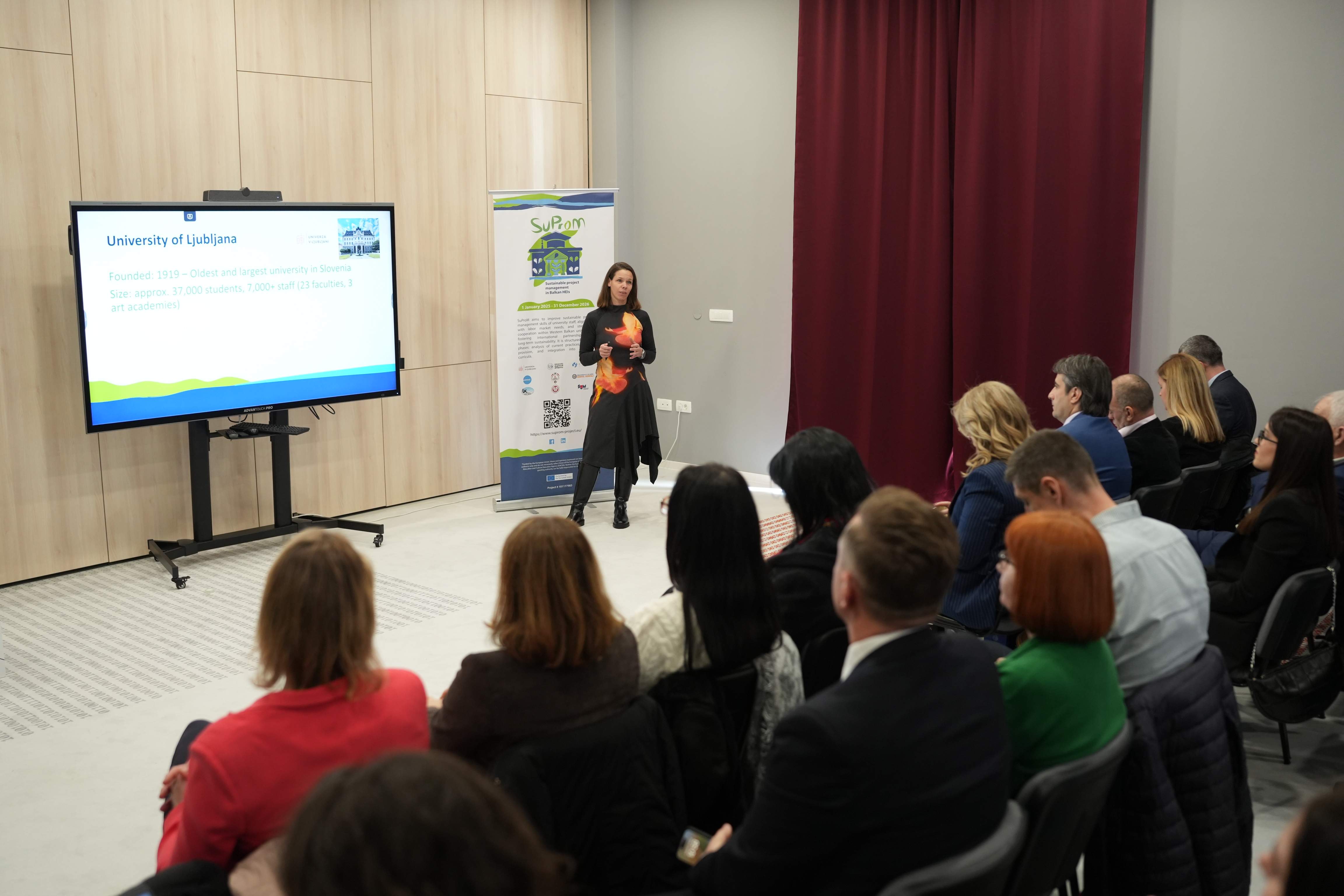
The SuProM project was presented by Vika Pušnik and Helena Kovačič from the University of Ljubljana, the project’s main coordinator, who highlighted the aim of strengthening institutional capacities, developing competencies, and integrating sustainability into all phases of project management at higher education institutions in the Western Balkans, with a particular focus on long-term value and practical application of acquired knowledge.
During the workshop, Ivan Jurilj, Director of the Office for European Integration, spoke about the importance of stronger collaboration between the scientific community and public administration, emphasising that cross-sectoral connections enable better preparation and implementation of EU projects. He noted that projects in this context become “platforms for joint action, aimed at creating higher-quality, sustainable, and long-term beneficial solutions,” highlighting strategic sectors for collaboration – from regional development and agriculture, to digital transformation, AI applications in public administration, and the development of the circular economy.
The first day programme included four key presentations and three interactive workshops, alongside thematic sessions focused on project roles, processes, and the implementation of EU projects. The lectures covered topics such as Bosnia and Herzegovina’s participation in the Erasmus+ programme, sustainable project management at universities, and the development of the knowledge, skills, and competencies needed for effective project management. Special emphasis was placed on practical examples, exchange of experiences between institutions, and the application of sustainability and impact in project development.
Katerina Malić-Bandur, project leader of SuProM at the University of Mostar, highlighted the project’s significance for both academic and administrative staff at SUM and its long-term impact on the academic community: “The project outcome represents the implementation of project management through the faculty study programmes at the University of Mostar. Implementation through SUM study programmes will contribute to an increased intensity and a higher number of EU-funded projects, which will, in turn, promote sustainable economic development and growth in macroeconomic indicators.” She emphasised the strategic importance of SUM as a partner in the Erasmus+ CBHE SuProM project, explaining that the project consists of three stages: analysing the current state of project management in higher education institutions, delivering training, and improving project management practices.
More than 60 registered participants actively took part in the first day of the SuProM workshop, engaging in discussions and practical activities that further strengthened their project and professional skills. The second day was dedicated to thematic workshops conducted by experts from the University of Ljubljana, focusing on project roles, processes, and EU project implementation through practical tools and examples of good practice.